Tall or small, quick or powerful, rugby has the rare quality of offering a place to every body type. It is even one of its finest strengths. Understanding rugby positions, their roles and their builds helps the beginner looking for a place as much as the spectator who wants to follow a match. Behind the fifteen numbers lies a perfectly clear logic, made of possession, strategy and speed. Here is the full tour of the positions, so you can find the one that fits your profile and your ambitions.
The 15 positions at a glance
A rugby union team is divided into two big blocks. The eight forwards, numbers 1 to 8, make up the pack, in charge of winning the ball and of the physical battle. The seven backs, numbers 9 to 15, form the three-quarter line, geared towards movement and scoring.
Each number matches a precise position and a defined role. The forwards bring together the props, the hooker, the second row and the back row. The backs bring together the half-backs, the centres, the wingers and the fullback. This universal numbering reads the same way everywhere in the world, which makes it possible to understand any team at first glance. Remembering this division into two blocks is the key to all the rest.
The forwards, the engine of possession
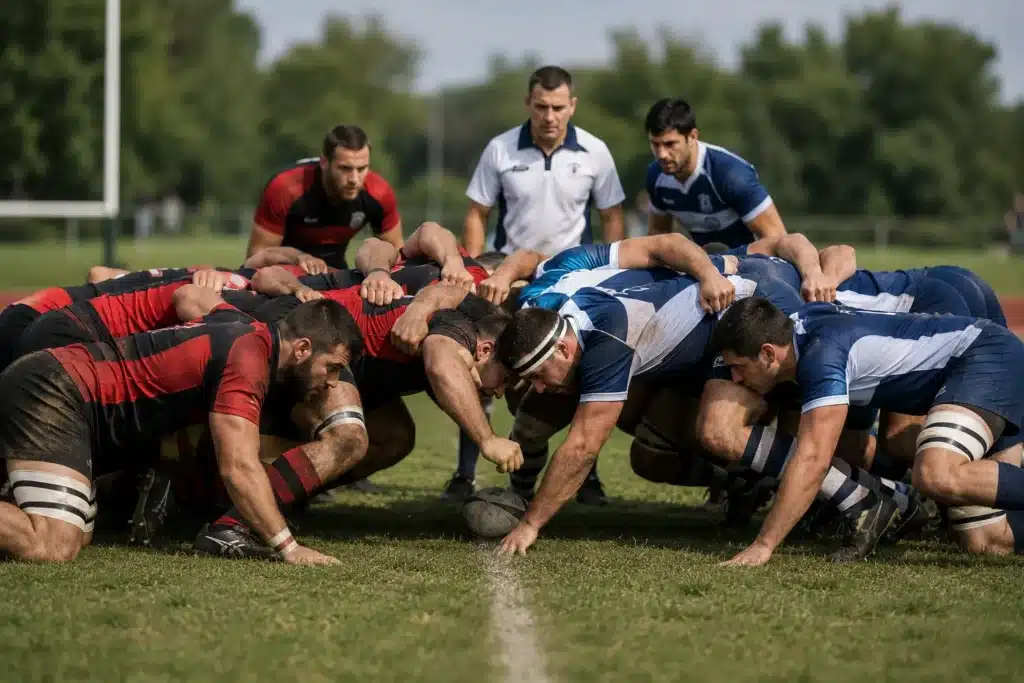
The forwards are the workers in the shadows, the ones who win the ball. In the front row, the two props and the hooker push in the scrum, a mission of pure strength reserved for the most powerful, stocky builds. The hooker adds to it the precision of the lineout throw.
The second row lines up the tallest players in the team, jumpers at the lineout and extra shove in the scrum. The back row, more mobile, blends power and endurance: the two flankers poach ball at the breakdown and tackle relentlessly, while the number 8 provides the link with the backs. Together, these eight men wage a permanent physical battle. Without their possession, no fine piece of play is possible, and that is why people say a match is won up front first.
The half-backs, the brain of the game
Between the forwards and the three-quarters, two players orchestrate everything. The scrum-half, number 9, is the vital link: small, sharp and talkative, he distributes the ball coming out of the rucks and sets the tempo with his voice. He is often the boss on the pitch, the one who decides how fast the game is played.
The fly-half, number 10, is the chief strategist. Goal-kicker, tactician and conductor of the attacking line, at every phase of play he chooses whether to pass, kick or run. His composure often decides the outcome of a match. These two positions call for game intelligence more than power. They suit players who like to read the game, decide quickly and direct their team-mates. The half-back pairing is the brain of the team.
The three-quarters, speed and finishing
Behind the half-backs runs the three-quarter line, in charge of finishing. The two centres combine speed and power: they hit the defence, create gaps and feed the wingers. The inside centre often carries hard, the outside centre distributes, but both tackle a great deal.
Out wide, the wingers are the team’s sprinters, tasked with touching down in the corner after one last beaten defender. The fullback, number 15, is the last line of defence: he takes the kicks, counter-attacks and defends the wide open spaces on his own, blending courage and reading of the game. These positions reward speed, comfort with ball in hand and a taste for the open field. This is where the spectacular tries are born, the ones that bring stadiums to their feet.
Which position for your profile
The beauty of rugby is that there is a position for every body. A tall and powerful player will find his place in the front or second row, in close combat. A sturdy, enduring build will thrive in the back row, between tackles and turnovers.
A sharp and clever player, even a small one, will work wonders at scrum-half or fly-half, where the head counts for more than the muscles. A fast, skilful profile will shine at centre, on the wing or at fullback. Rugby is one of the rare disciplines in the list of sports where the diversity of body types is a strength and not a handicap. That is what allows such different players to make up one tight-knit team.
The body according to the position, a point not to be overlooked
Every position exposes the body differently, and beginners are well advised to know it. The forwards absorb the repeated impacts of the scrum and the rucks, putting strain on the neck, shoulders and back. The backs, for their part, are exposed to tackles at full speed and to catching high balls, with their share of sprains and traumas.
Whatever the position, rugby remains a contact sport where physical preparation and good technique protect you above all else. Learning to tackle cleanly is essential, as our guide on how to tackle safely explains in detail. A licence sets a framework, but treatment for a shoulder or a knee falls to a rugby personal accident insurance, a real safety net for a season of contact.
Positions and their profiles
| Numbers | Position | Profile |
|---|---|---|
| One to three | Front row | Power, scrummaging |
| Four and five | Second row | Tall builds, lineout |
| Six to eight | Back row | Mobility and impact |
| Nine | Scrum-half | Speed of execution |
| Ten | Fly-half | Vision and kicking game |
| Eleven to fifteen | Three-quarters and fullback | Speed and evasion |
The best position is the one where you enjoy yourself
There is no position superior to the others, only the one that looks like you. The prop savours the scrum won, the winger the try in the corner, the fly-half the match-winning penalty. The best advice for a beginner fits in one sentence: try things, experiment, and follow the enjoyment. Many great players changed position before finding their own. Push open the door of a club, a coach will guide you according to your profile, and the pitch will do the rest.